Showing posts with label duties. Show all posts

26 December 2011

Library Cleaning Poster

Through the use of a couple of strong visuals, font use and language,
  a simple informational sign can have greater impact and appeal.

Every month a different department in our Headquarters Library will volunteer to clean the staff break room. We have a schedule on the staff refrigerator that shows each department's rotation in this duty. With 12 different departments at Headquarters, it works out pretty well: we only have to get our hands dirty cleaning once a year in what can sometimes be an ugly experience. But to our staff's credit, we're a pretty tidy bunch of folks. Nevertheless, that doesn't mean there won't be plenty of spaghetti splatters all over the inside of the microwave from time to time.

Thus, the inspiration for this sign, indicated that it was MY department's turn to wipe down the break room. Typically, the signs most people from other departments make are simple text signs with a couple of tiny pieces of Microsoft Word or Publisher clip art dropped in as decoration. But not for me. I wanted to show something with greater visual impact.

I didn't have to go far into my files and on the internet to find a few messy eaters, a bib, and our logo to cobble together a simple and straight-forward visual message to let staff know to safe guard their refrigerator items from being thrown out before volunteers got there with rubber gloves and cleaning supplies. I copied a section of the boy's face and pasted it down onto the product shot of a clean bib, adjusted the lighting and colour, then copied and pasted additional selections of the mess and spread it around for even more coverage on the bib and face.

And for those who are prone to be exceptionally messy, I wanted to let them know that while we might clean up the mess, we wouldn't be cleaning up those who make it--no matter how much they might need it!

Library Design Projects: Quality vs Quantity

I've been tardy in adding entries to the blog as of mid-November. It's not because I didn't have projects to show. No, on the contrary, I've been so busy that by the time I returned home and stopped my regular work on design projects there, little time or energy was left to write even one more dang thing about design. 


In the 36 work days since the beginning of November until 23 December, I've created 113 unique projects, some of which contain design variations within the same project. So if I'm doing my math right, that's just over three projects per day that I'm completing and shipping out of the department for the library district. I always do the best that I can within the parameters I have to work with, but that's real quantity-vs-quality stuff in my book. So when people requesting new work wonder why I start whining about how pressed for time I am, there's the big squeeze in numbers above for all you bean counters.


With my blogging tardiness in mind, I'll play a little catch-up on it by posting some of the more notable projects I've worked on for the library since my last entry on 16 November. I hope you'll find something you like!

17 October 2011

Library Safety Irony

Last week one of the facilities guys came into the art room  turned on the large laminator that had a 24 inch roll of film in it, then proceeded to begin trimming an 8.5x11 inch page into tiny 1x1 inch slips on the paper cutter. 


I looked over and asked what project he was working on. He said he needed to laminate a ten copies of a list of codes that each member of his department could then tuck into their wallets for future reference. I tried to envision him poking his 1x1 inch scraps of paper into the big 24 inch wide roller of the laminator...and all the wasted film that was sure to result.


"Hey, I have an idea," I said. "How about we use our little laminator that makes ID badges. You can put two of those little slips into one sleeve each, then trim them down to size. It's really fast and you won't even have to wait for the machine to warm up 15-20 minutes like the big laminator." 


"Oh, ok. I was just going to do it the way I done it the last 17 years," he said. "Let's give this a try, and you'll see how easy it is," I encouraged him, wondering just how much film had probably been wasted over the course of the past 17 years.


I pulled out the small ID badge laminator, plugged it in, and let it warm up while my facilities friend trimmed out all the lists on the paper cutter. While he was chopping away, he got interrupted by a call on his cell phone. "I'm laminatin' and choppin' these lists," he repeated a few times into his cell phone. "Yeah, laminatin' and choppin'. Safety meeting? Okay. Right now? Okay. Be right there." He turned to me and said he'd come back to finish right after his facilities safety meeting. Since I already had the little laminator ready to go, I offered to finish the laminating and trim them out, two-to-a-single card size. They'd be ready for him by the time he returned. He thanked me and headed out while I began folding the lists, placing them two-to-a-plastic sleeve, and poking them through the laminator. When they were all laminated, I unplugged the laminator and turned to carry it with me over to the paper cutter where I could finish trimming the newly laminated lists. 


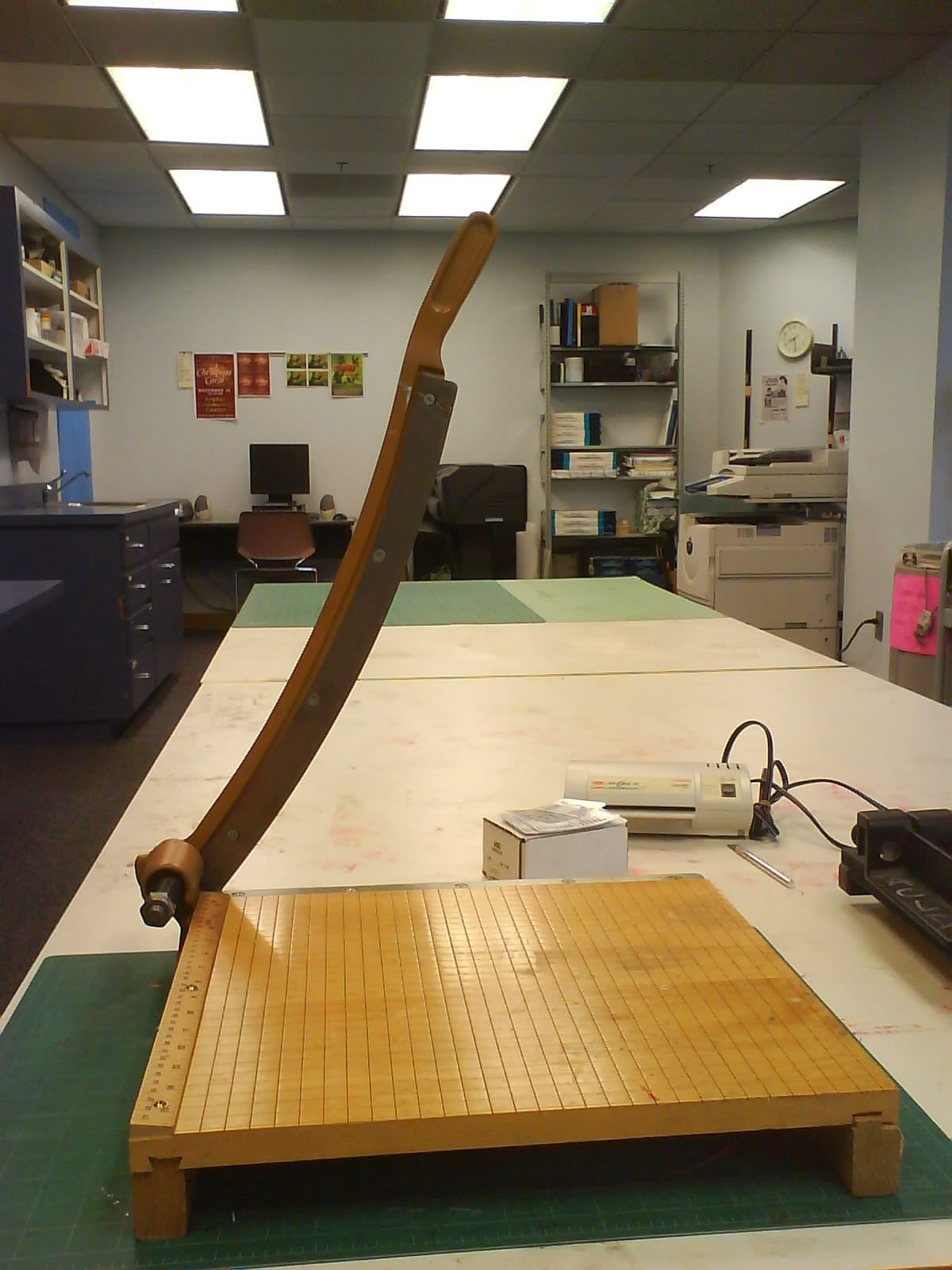
In an ironic twist, the user ran off to a safety meeting,
leaving the paper cutting arm up in this position.
What I saw when I turned around was this: the paper cutter blade positioned exactly as you see it above. I couldn't help but to see the irony in it: Facilities Guy Leaves Paper Cutter Arm In Up Position During Hurried Dash to Attend Safety Meeting.


I had a good chuckle at it, but this is the kind of mentality many people have when they come into the art room to do a project. They pull out all the materials they need to do their project, then when they're done, they just leave it for someone else to pick up after them...that "someone" being me I guess. Never mind that it wasn't my project nor my mess. I find myself both cleaning up, and when I next see them (or hunt them down immediately after) I let them know that part of the creating process includes the cleaning up step afterwards too. Art room etiquette, my friends!...and oh yeah...SAFETY too! 


Thank you very much for being mindful of this public service announcement. =)

28 October 2010

Who Do I Serve?

As the designer for the Alachua County Library District, I serve a variety of different people both directly and indirectly. The corporate hierarchy places me under supervision of the Public Relations Assistant to the Library Administrator, who serves the Library Administrator. Beyond this, the Library Administrator serves the Library Board of Trustees, who in turn take direction from the Library District Governing Board. The board serves the greater community.


I perform my duties largely autonomously and unsupervised, but I work in tandem with my supervisor as needed and in response to some projects approved by her, while others are not. I defer to her with any questions I may have regarding corporate governance and oversight related to design issues, material and equipment purchases, workflow management and reporting, and a historical perspective on older projects that may need updating or redesigned. 


The company that pays the bill for services rendered is, of course, the client, but for those people who send me project requests, I like to think of each of them individually as my clients. These are the people whose project criteria I must fulfill and the people who I want to have walk away satisfied with my efforts.


I may be assigned projects by my boss, the Marketing and Public Relations and Manager. I might also receive requests from the Library Director either directly or through my boss. I also receive project requests from any administration staff member, from the Public Service administrators, the Literacy Coordinator, Automated Services, Circulation, or even Facilities. 


But by and large, the majority of requests I fulfill on a day-to-day basis are made by librarians of all levels, from program and event coordinators to branch managers. And in turn, the patrons are the consumer end-users of the products and services we offer and promote.